by Brian de Lore
Published 2nd October 2026
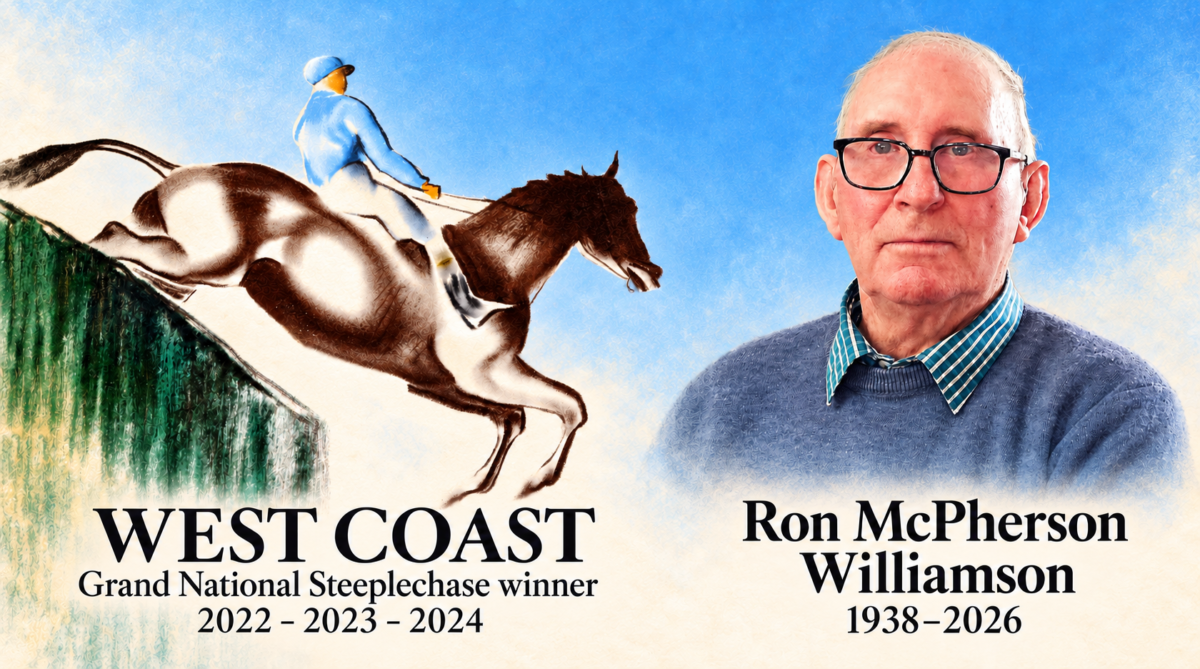
Racing, and especially the wider jumping community, lost one of its greatest supporters early on Tuesday morning when, sadly, my good friend and a friend of so many in racing, Ron Williamson, passed away at the Croft Rest Home in Timaru.
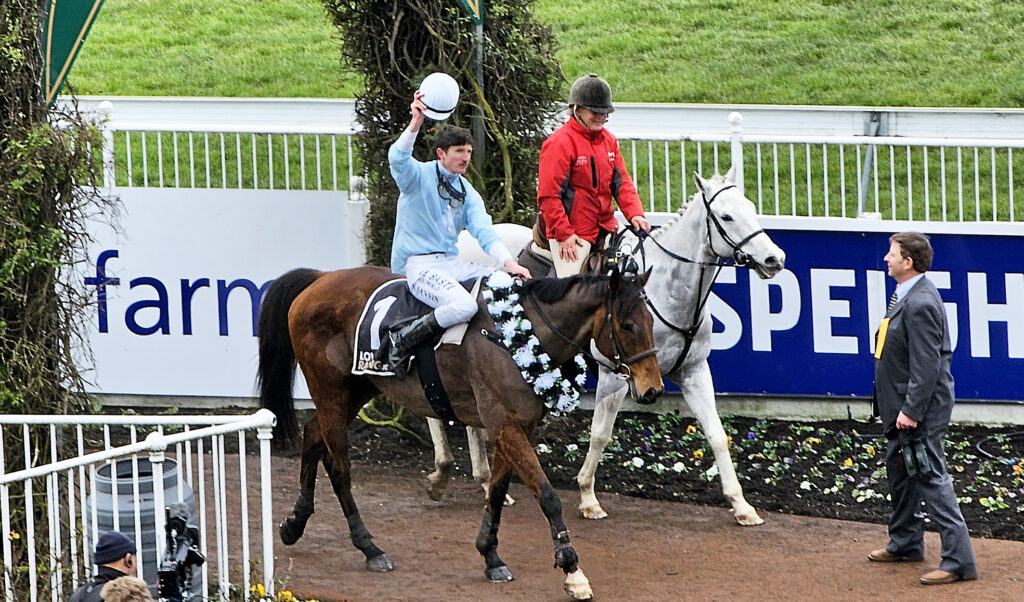
Ron will be known to most racing people in recent times as the principal owner of Champion Steeplechaser West Coast, the only horse in history to win three consecutive Grand National Steeplechases at Riccarton, a magnificent feat which the horse backed up with consecutive wins in the Great Northern Steeplechase at Te Rapa.
Ron was the epitome of a show jumping-steeplechase man through and through. When the legendary Taranaki trainer John Wheeler was interviewed on Trackside at the recent Te Aroha jumping meet, he said, “The best people in racing own a jumper, and all the good horsemen come from the jumping arena, and if jumping goes, God help us.”
John’s words echoed an observation made decades earlier by John Hislop, the breeder-owner of Brigadier Gerard, in his book Steeplechasing. Hislop considered the camaraderie, friendships and shared love of the thoroughbred within jumping more rewarding than anything he had encountered in flat racing.
A man of strength and character who deserves to be remembered alongside his farming, his family and his lifelong contribution to horses and racing
Both Johns were generalising, but they could have easily been referring to Ron Williamson, a highly principled man from a past generation, a man whose mental strength kept him going through 62 years as a paraplegic, a man who endeared himself to everyone in racing, and especially the jumping fraternity, and a man whose strength of character deserves to be remembered alongside his farming, his family and his lifelong contribution to horses and racing.
Each was a substantial part of his life.
In 2009, Ron received the Mercedes Award for Outstanding Contribution to Racing at the Horse of the Year Awards. It recognised his continuous contributions to racing accumulated over many years.
I admired him greatly, and writing about his life brings home how difficult it is to do justice to someone whose character meant more than any list of achievements can convey.
Ron loved and lived for West Coast’s success in recent years, an ownership he shared with his lovely wife Jennifer and family. That joyous sharing in West Coast’s success was a highlight for the Williamsons and gave Ron a reason to smile over the past seven years.
But that joy for Ron ended on June 13 this year when West Coast fell in the Waikato Steeplechase about 1000 metres from home and fractured a shoulder, necessitating the great jumper to be humanely euthanised.
West Coast won 12 of 21 starts over the big fences
West Coast won 12 of his 21 starts over steeplechase courses and was one of the safest jumpers in living memory. Over the big jumps, he never finished further back than 4th, except in one race when he was pulled up at Woodville, after which he was found to be lame. He had never fallen until that fateful day.
Ron was devastated by the loss of West Coast, and the disappointment he carried over the ensuing months would not leave him, contributing to a deterioration in his health and bringing about the need to leave his Twizel home and enter Timaru’s Croft Rest Home for the last few weeks of his life.
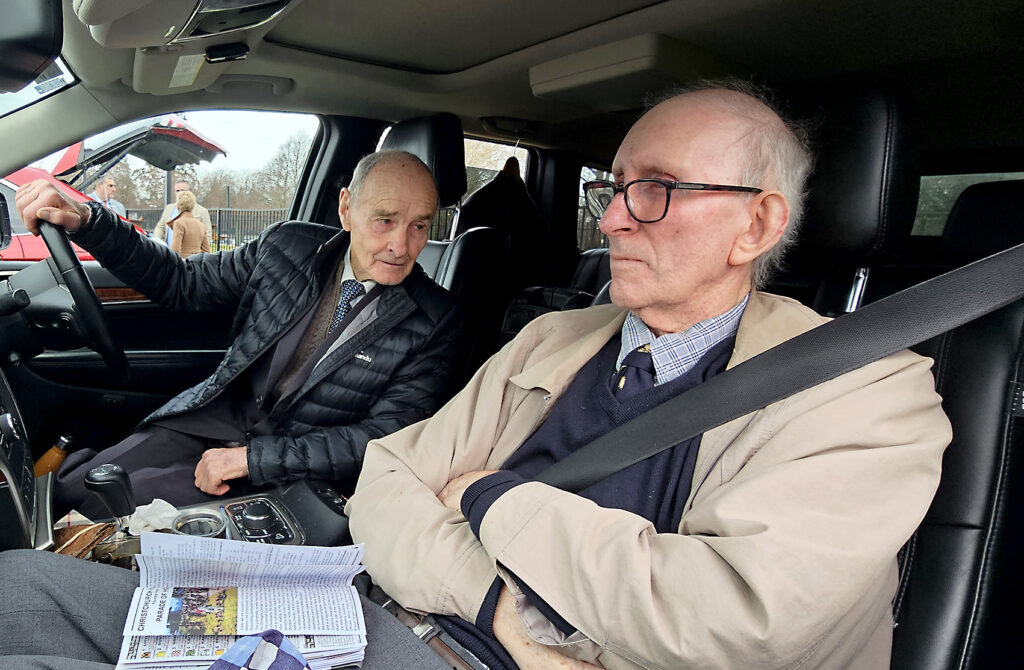
On Grand National Day this year, the family drove Ron from the rest home to Riccarton, where he sat in the car to enjoy the racing in front of the grandstand adjacent to the bird cage, and reacquaint himself with dozens of his racing friends. Sadly, it would be the last time most of them would see Ron.
In his youth, Ron was a top-class showjumping rider, considered good enough to contend for the 1964 Olympic Games, but before the squad was selected, he did not have a showjumper capable of competing at that level.
Early in 1964, Ron’s father, Ted, tried to buy a very good showjumper in Hawke’s Bay named Ali Baba, owned by John Frizzel. John wanted £1000, and Ron and his father travelled to Hawke’s Bay to test-jump Ali Baba at the local showgrounds. They liked the horse, and Ted offered £950 plus £50 if the horse qualified for the Olympics.
John (Frizzie) held out for the ‘grand’, and the deal was never done, but for John and Ron it was the start of a lifelong friendship that endured at a fast pace for more than 60 years.
In November of that same year, tragedy struck when Ron, riding a showjumper, failed to negotiate a jump at the Timaru AMP show, an accident he blamed on himself and not the horse. Ron suffered a serious spinal injury, and the doctors told him he would never again walk. Ron’s strength of character got him through the trauma, and he defied the doctors by walking on two sticks for almost all of his life as a paraplegic.
The Williamson family began its association with the 23,783-hectare property, Birchwood Station, in the Ahuriri Valley near Omarama in 1942, when Ron’s father, Edgar (Ted), negotiated a leasehold tenure.
Ron was born in Ranfurly in 1938, then moved with the family to Birchwood at age four.
The Government purchased the property in 2004 under the Crown land tenure-review process, and announced, “Birchwood is one of the crown jewels of the high country – there are very few properties like this.”
The Minister of Conservation at the time, the Hon. Chris Carter, praised it explicitly. He attributed the survival of unusually unmodified valley floors to the family’s farming over 62 years and said: “The Williamsons should be congratulated for their stewardship of Birchwood.”
The Williamson family’s association with Birchwood extended over three generations. As many as 7000 Merinos grazed the mountain country, 300-350 Hereford cattle ran on the valley floors, and musters on horseback could take eight days to complete.
Snow, rabbits and deer all exacted their toll. The country was demanding for the Williamson family, and sometimes Ron’s father earned more from rabbit bounties than wool.
Ron rode trackwork for Phil Andrews at Washdyke and became an amateur jockey
Ron’s father had horses with Phil Andrews at Washdyke, where Ron rode trackwork for the stable before becoming an amateur jockey. On Grand National Day this year, while chatting in the car, Ron recalled riding in an amateur race at Riccarton when he was only 16, finishing second to a Hector Anderton-trained horse.
Ron became a regular sponsor of Otago jumping races to help sustain the sport in the South, and he contributed 19 years as President of the Kurow Jockey Club. His support extended to equestrian sport. The NZ Horse Society, renamed Equestrian Sports New Zealand, identified Ron in 2019 as the South Canterbury North Otago patron, with Grand Prix and open jumping classes carrying his sponsorship.
The Williamsons raced many horses over the years, and as with all owners, many were slow; some were good, but none were as good as a horse named West Coast. He replaced another successful horse, Residential, the winner of nine races, including the Gr.3 Valachi Downs Thoroughbred Breeders Stakes at Riccarton.
Residential was leased to Ron by Waikato Stud. When she retired for the 2019 breeding season, Ron and Henry decided they would buy a potential jumper and asked Mark Oulaghan to look out for one.
He came up with West Coast, which had raced twice for two unplaced runs over 1600 and 2000 metres. They purchased him for $20,000 on 1st November 2019. He won $641,000 in stakes, giving Ron the best ride of his life.
Ron may be gone, but he will never be forgotten. He will live on in our memory and in the annals of New Zealand steeplechase owners.
It was a privilege to know and spend time with Ron McPherson Williamson.
Vale Ron.
Death Notice appearing in The Press, Christchurch 1st, October 2026
Ron Williamson passed away peacefully at The Croft Rest Home on Tuesday, September 29, 2026, at age 87. Dearly loved husband of Jennifer. Loved father and father-in-law of Simon and Kirsty, Henry and Gabriela. Beloved grandfather of Ted, George, Ben and Jessica. A memorial service for Ron will be held at the Omarama Memorial Hall, Omarama, on Tuesday, 6 October 2026, at 2.00pm.
A fitting well compiled tribute Brian potraying the qualities of a wonderful gentleman and passionate horseman in Ron.His legacy will live on for years to come I was so pleased to have met him along with his family at Grand National time- so special.RIP Ron.
Fondest thoughts,
Norm Withers MNZM.
Another wonderful tribute Brian, enjoyed it immensely
Hi Brian obviously he was a great man and what a wonderful tribute you paid him , unfortunately I never had the pleasure of meeting him but from how you described him they don’t make them like him anymore unfortunately , always enjoy your articles Tommy
so very sad to hear this.
A wonderful man and family.
Im very grateful to have trained Birchwood Run for John Frizzell and Ron Williamson
Rest in Peace xox