by Brian de Lore
Published 26th July 2026
Two highly detailed documents compiled by the TAB New Zealand Racing Advisory Committee are the most significant and damning narratives produced for New Zealand racing since the Messara Review reached the Minister’s hands exactly eight years ago (27th July 2018).
Supported by extensive research and industry analysis, they conclude that the current operating model for racing is no longer fit for purpose and that meaningful structural reform is essential if the thoroughbred and harness codes are to achieve a financially sustainable future.
The smaller 15-page paper entitled ‘New Zealand Racing: The Financial Position’ outlines the acceleration of costs of NZTR (45%) and HRNZ (38%) since 2023 and provides irrefutable evidence of the looming financial crisis. The second, a comprehensive 54-page paper entitled “New Zealand Racing Industry Reform – A Strategic Imperative for a Sustainable Future” provides details of five expanded recommendations for a sensible fix for both horse racing codes.
The documents are the findings of the TAB Advisory Committee (AC), formed around 15 months ago to identify the problems and propose a fix. Last December, they submitted their financial forecasts and recommendation for restructuring to the two codes, but received a dismissive response.
The financials audited by KPMG
When they resubmitted to the codes in March this year after all boxes were ticked following a full audit by KPMG, NZTR intimated they could not trust the same auditors that acted for TAB NZ and scrutiny by their own auditors would be required.
In essence, this is what the TAB AC is saying: “The industry’s governance structures are driving operational inefficiency, a lack of accountability, and money invested at the administrative level instead of focused investment to grow industry outcomes.
“If the system stays as it is, the compounding loops (the “negative flywheel”) of fewer horses, weaker product, a bloated cost base and unreliable venues will see the industry slip back toward its pre-2023 decline. Any efforts to work around these issues have been tried for decades and have not changed the trajectory.
“Consolidating governance, unlocking assets, stabilising supply, and lifting efficiency are now essential. Incremental steps will not hold the line; a coordinated reset is required now to avoid a material fall in funding, participation and export strength after the 2027/28 season when the industry’s guaranteed funding period comes to an end.”
The AC’s referencing the ‘pre-2023 decline’ is a pointed reminder about racing arriving at the brink of bankruptcy in the days before Entain arrived with its saving millions.
Poor administration the main problem
What the AC Financial Position report is saying is that its administration, and not stakes money, is what’s consuming a growing percentage of the funding. Using the industry’s own forecasts, it reveals the NZTR, HRNZ, TAB, and RIB operating costs are forecast at $91 million in FY26, representing 58% of stakes returned to participants.
It also compares NZ costs against Australia and claims we unnecessarily cost $23 million more in administration expenses compared to our contemporaries across the ditch.
TAB NZ is guaranteeing funding to the codes will only be held flat and not increased through to 2029. The two remaining codes after August 1st will get $159 million between them for the coming season, but also want from the TAB the $26 million that would have gone to fund the Greyhound code for the coming season – why are the administrative costs increasing in a shrinking industry!
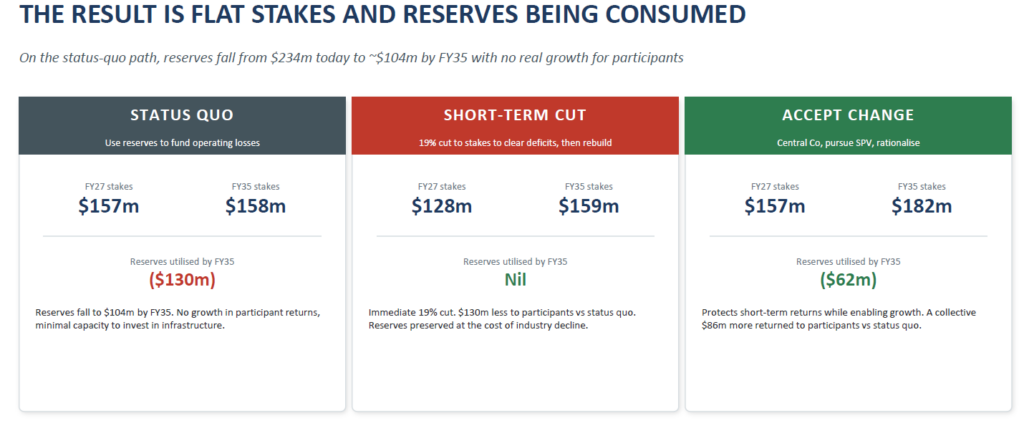
The AC also says that if we keep the status quo, stakes by 2035 will be the same as today, but we will have used up $130 million of reserves and have no capacity to invest in infrastructure. One alternative would be to cut stakes from $157 million to $128 million for 2027 (19% cut) to keep reserves at the current level and be back to $159 million for stakes by 2035.
The third option is to immediately accept the changes proposed by the AC by rationalising costs to maintain stakes at the current level for 2027, which would allow stakes to grow to $182 million by 2035 while retaining reserves of $62 million. These figures have been audited by KPMG.
This is not really an argument about money though; it’s a mandate against the entire regime known as NZTR (and HRNZ), both at board and executive level – addressing the crucial issues of governance, accountability, administration and structural reform.
NZTR has been a steadily growing malignant tumour for well over a decade, and it now requires an exorcism using the full force of the stakeholders, because it will not recognise its own shortcomings and budge of its own accord. A combination of ostrich-like behaviour, ignorance, and self-interest has emerged after NZTR received the detailed work tabled by the AC.
The AC was formed to make recommendations and has no official power, but the irony is that they were selected from a mix of highly successful businessmen, all of whom have significant investments in racing, either full-time or part-time. They are the people who know what works.
The people at NZTR are mainly, but not all, non-racing people who have arrived via the Institute of Directors, the casino business or other industries not related to racing. They are simply the wrong people to take charge of an industry for which they have no passion or long-term future commitment. They are there for either employment or a well-paid directorship.
Chair of the NZTR board, Russell Warwick, resigned his position as Chair two weeks ago at the request of the Members’ Council, but he remains on the board until November and is likely to be replaced by a person named Humphries. It doesn’t improve, only gets worse, and the board is defiant.
The NZTR board possesses all the quintessential attributes for failure around the board table. It starts with insufficient experience or understanding of the industry, continues with a lack of knowledge needed to understand the complex issues of racing, which leads to a lack of engagement with the participants, and this board has clearly demonstrated its failure to adequately identify and assess risks, or take appropriate action to secure the industry’s financial sustainability.
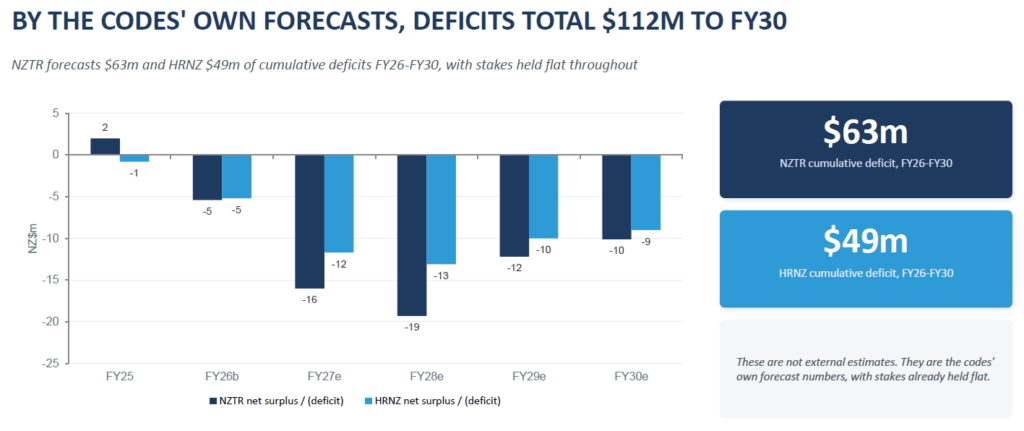
Even by NZTR and HRNZ’s own forecasts, their combined deficits to the year 2030 total $112 million, and that’s with a zero increase in stakes over four years.
For thoroughbred racing, it’s now up to the racing clubs of New Zealand to call a Special General Meeting and move a vote of no confidence in the board of NZTR.
The NZTR Constitution says, “at least five (5) Voting Members representing at least 10% of the total voting rights can request an SGM in writing. The request must clearly state the business to be considered, with enough detail for Members to understand the purpose.
“Notice of an SGM must be given to all Members at least 20 Working Days before the meeting.”
Vote of no confidence an option for racing clubs
Failure of the clubs to take this action will see a continuance of the status quo, and according to the AC financial forecasts, backed by the audit of KPMG, racing is heading down the highway of hell. Will the clubs have the nous to do it? It’s doubtful they possess enough testosterone.
After carefully reading all the arguments provided by the AC over 69 pages in both documents, the narrative was so familiar; it led me to go back over more than 150 posts logged on this forum over the past decade.
Several of the blogs, dating back a long way, had these headlines: “Governance of NZ Racing still in the 20th Century” – “Transparency and accountability badly needed” – “Much more required than a performance and Efficiency Report” – “Racing stakeholders fed up with deception and misinformation.” There are dozens of them – all archived here on this website as a researched opinion by yours truly.
For almost a decade, The Optimist has argued that the greatest threat facing New Zealand thoroughbred racing has not been its horses, breeders, trainers or owners. It has been the way the industry has been governed.
Over that period, The Optimist has continually examined governance, administration, leadership, accountability and strategic direction. The recurring theme has remained remarkably consistent: New Zealand racing did not need another short-term fix. It has needed structural reform for many years.
Many disagreed. Others dismissed the concerns as being overly critical. Still others told me The Optimist’s negativity was damaging, but the truth is the damage was continually recurring at an administrative level, and these pages merely reported it.
Now an independent Racing Advisory Committee with validated authority has completed a detailed review of the industry’s financial position and governance. Its conclusions are striking, and not because they are new, but because long-term readers of this forum will be familiar with the narrative. The argument has been repeated on these pages since 2017; finally, people with clout have agreed in writing.
| The evidence has caught up | |
| The Optimist (2017-2026) | TAB Advisory Committee (2026) |
| Governance outdated | Governance driving inefficiency |
| Administration too large | Administrative expenditure too high |
| Accountability lacking | Lack of accountability |
| Structural reform needed | Structural change required |
| Incremental change won’t work | Incremental steps won’t hold the line |
| Industry needs reset | Coordinated reset required |
Have your say below.