by Brian de Lore
Published 2 November 2026
In the 100 years since Spearfelt won the 1926 Melbourne Cup, the most obvious change is that the race is no longer a contest for Australasia’s best stayers, but an international event for elite stayers from both Hemispheres, now mostly from the north.
As an international race targeted by quality Northern Hemisphere horses, it has continued to raise its reputation as an event that not only stops two nations, but many other racing fans from nations around the world. The drawback from past days in Melbourne Cup history is that Australasian racegoers are unfamiliar with many of the horses.
Unlike Spearfelt’s day, when the record crowd of 118,877 (broken only once since in 2003) knew the form of every runner and punted accordingly, this year’s Cup is inundated with invaders – nine of the 24 acceptors (37.5%) have arrived from the north to contest the race at only their first or second Australian start, but overall, the field is 75% from north of the equator.
Australasia represented by only 25% of Cup field
The 24 acceptors comprise four Australian-breds, two New Zealand-breds, and 18 horses bred in Ireland (9), Great Britain (7), France (1), and the USA (1). In Spearfelt’s Cup of 1926, the 21 starters included Australian-breds (15), Great Britain-breds (3), and New Zealand-breds (3).
We applaud the quality of thoroughbreds competing in the race in 2026, but are the rags-to-riches stories from bygone days gone? -such as the unwanted dairy farmers’ horse from Mangaweka near Taihape, named Wotan, winning the Cup at 100/1 in 1936, or the Victorian hobby-breeder, L.O. Menck, who purchased a two-season failed city horse for country racing for £150.
Menck bought Colonus in 1942, only months before the Cup, thinking he and his trainer had bought a big chestnut, but when they inspected him, they realised they had made a mistake: he was a small bay horse. Trainer Frank Manning had mixed him up with a horse called Burberry.
Manning threw caution to the wind and tried the horse as a stayer. He started him in the Herbert Power Handicap and, using front-running tactics, Colonus led all the way and won easily, prompting his owner to back him to win the Cup at 200/1.
On Cup Day, the track was a quagmire after torrential rain; the type of going on which Colonus had displayed the best of his dubious form. On the day, his odds plummeted from 200/1 to 33/1, despite barrier 24 and an inexperienced 17-year-old apprentice jockey named Harry McCloud.
McCloud took Colonus straight to the lead and, revelling in the going, led all the way to win by seven lengths, giving his owner an estimated £60,000 winning result from pre-post betting.
Two romantic stories from scores of similar tales from 165 Melbourne Cup runnings that have made the race such a great, historical event. But the modern-day ‘Cup’, with its international influence, has greatly reduced the chance of another Kiwi or Aussie battler adding such unlikely victories to the Cup’s history.
The first Northern Hemisphere winner, Comedy King in 1910, was imported by the famous Solomon “Sol” Green (1868–1948), a London-born bookmaker who became a wealthy Australian racehorse owner, breeder, property investor and philanthropist.
The next winner from the north, Backwood (1924), was followed by Beldale Ball (1980). Then came At Talaq (1986), the first of 20 more NH winners in the elapsed 40 years of Cup winners to 2025, the latest being Without A Fight in 2023.
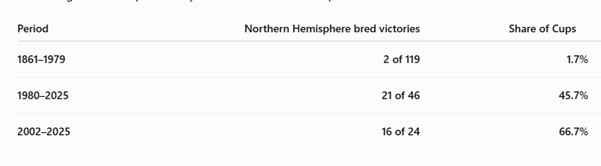
Through 2025, 21 individual Northern Hemisphere-bred horses have won 23 Melbourne Cup victories. Makybe Diva’s three wins account for the difference.
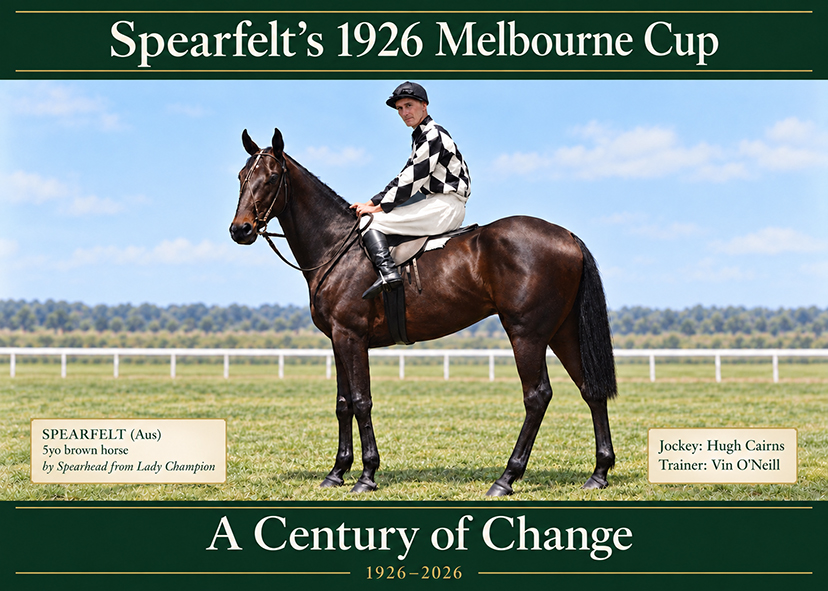
The 100-year-old Spearfelt story had just as many twists and turns as Wotan and Colonus. Returned Aussie WW1 soldier Douglas Grant bought the orphaned-at-birth youngster for 120 guineas using deferred army pay. His breeder, John Vincent Smith, had spent years trying to breed a Cup winner but died before Spearfelt achieved it.
Grant instructed his New Zealand-based Melbourne trainer, Vin O’Neill, to buy him a yearling carrying Carbine blood. He bought a great-grandson of Carbine through his imported grandson, Spearhead, in turn a son of the English Derby winner, Spearmint, and named him Spearfelt.
New Zealand jockey Hughie Cairns had won the W.S. Cox Plate on Heroic 10 days earlier and would have ridden Heroic in the Cup, but when the horse was withdrawn, the Palmerston North-born Cairns became a late replacement for Spearfelt’s jockey, George Young. Thus, Cairns became the first jockey to ride the Cox Plate-Melbourne Cup double.
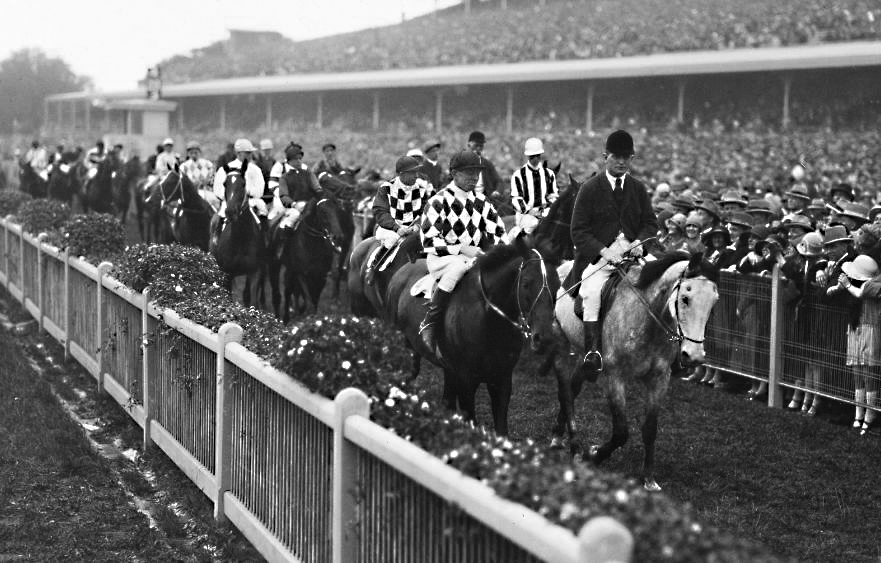
Owner Douglas Grant showed his sportsmanship to his original jockey, George Young, by agreeing to pay him, as compensation, the winner’s percentage, which amounted to £485. He could afford to; Spearfelt was heavily backed on the day, firming from 25/1 to 10/1.
The Cup of 1926 had 21 starters: 15 were Australian-bred, three came from NZ, and three carried the GB ID. The NZ-bred Naos, a son of Martian and NZ Cup winner Lady Lucy, carried only 7 stone (44.5kg) and finished a half-length behind Spearfelt in second, with the tiring imported horse Pantheon in third.
Naos was owned by the then retired bookmaker Sol Green, who reputedly arrived at Flemington in a gold-plated Rolls-Royce, wearing a hat and spats and smoking a Havana cigar. The horse was trained by former Kiwi, Lou Robertson, who one month earlier had saddled up Naos to win the Coongy Handicap.
A week later, Naos was offered for sale at auction but passed in at 1200 guineas. A day later he was sold privately to Caulfield trainer, Frank Godby.
Lou Robertson had an extraordinary career across both racing codes. Before becoming a leading thoroughbred trainer, he had been a successful harness trainer and driver in New Zealand and Victoria. He eventually earned places in both the Australian Racing Hall of Fame and the Victorian Harness Racing Hall of Fame.
Robertson trained the Australian-bred Marabou to win the 1935 Melbourne Cup, ridden by Champion NZ jockey and Hall of Famer Keith Voitre, who was tragically killed in a race fall at Moonee Valley only three years later, aged 25.
The Banker stood to win his owner over 100,000 pounds in 1926
The 1925 New Zealand Cup winner, The Banker, finished fifth to Spearfelt in the Cup. His Christchurch owner, Mr Otway Falkiner, coupled The Banker and Manfred for big money, with the same two horses to win the Caulfield-Melbourne Cups double. Manfred won the Caulfield Cup, beating The Banker, but Manfred was scratched from the Melbourne Cup.
When The Banker finished a three-length fifth, it denied Falkiner a bookies payday of £104,000, a huge amount 100 years ago, estimated to be roughly A$10 million in today’s consumer purchasing power, but equivalent to several hundred years of a working man’s wages at the time.
The disappointment of the 1926 Cup was the champion Kiwi-horse, Limerick, which finished 13th. The press reported he didn’t stay, but Limerick’s preparation was compromised by heel trouble; a later detailed history says the wound reopened during the Cup. Limerick won 29 races in both countries between 1925 and 1931.
Spearfelt won in 3.22.75 for the two miles. Converted to today’s metric distance of 3200 metres, the time comes back to 3.21.57. The 2016–2025 average, calculated from Racing Australia’s ten winning times, is 3:20.69—only 0.89 seconds faster than that adjusted figure.
Spearfelt would be competitive today on times
A century of breeding, international recruitment, scientific feeding and improved preparation has produced surprisingly little separation on the Melbourne Cup clock. Spearfelt’s 1926 time remains competitive with modern winning times. It challenges any assumption that today’s stayers are markedly faster than the best of their predecessors.
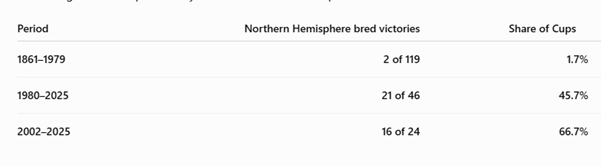
Northern Hemisphere-bred horses won only two of the first 119 Melbourne Cups, but have won two-thirds of the past 24. That is a substantial change in the race’s character—and it began with imported horses trained locally, well before Vintage Crop’s breakthrough for an overseas trainer in 1993.
New Zealand-bred horses have won 44 of the 165 Melbourne Cups (26.7%), through 43 individual horses. Think Big accounts for the extra victory, winning in both 1974 and 1975. Martini Henry was the first in 1883; Verry Elleegant the most recent in 2021.
The strongest period was between 1947 and 2001, when NZ-bred horses won 33 of the 55 Cups (60%). That’s a striking comparison with just two NZ-bred runners in this year’s field.
The 2026 Melbourne Cup field is again wide open. On the score of getting the distance, current form, stamina and weight, I’m thinking Middle Earth (3rd in 2025), Goodie Two Shoes (2nd in 2025), Soul of Spain (2nd in the 2026 Sydney Cup), Knight’s Choice (won the Melbourne Cup of 2024), and Kizlyar (1st 2026 Ascot Stakes of 4023m).